Today we are at the midpoint of the Mercury retrograde cycle, having just met the same cazimi moment of the Venus cycle. Time for a little publishing update from the Centaur Space! With the recent forward movement of Jupiter in Gemini, we prepare to experience a final tense aspect between major movers Jupiter and Saturn in their present signs before they move on to Cardinal climes this summer. Remembering back to their Great Conjunction in December 2020 feels like an aeon ago. Their back and forth square in mutable signs has felt like Sisyphus on a Slip’n’slide. Much will change when Neptune enters Aries next week, and Jupiter settles into Cancer like a happy hippo, this June.
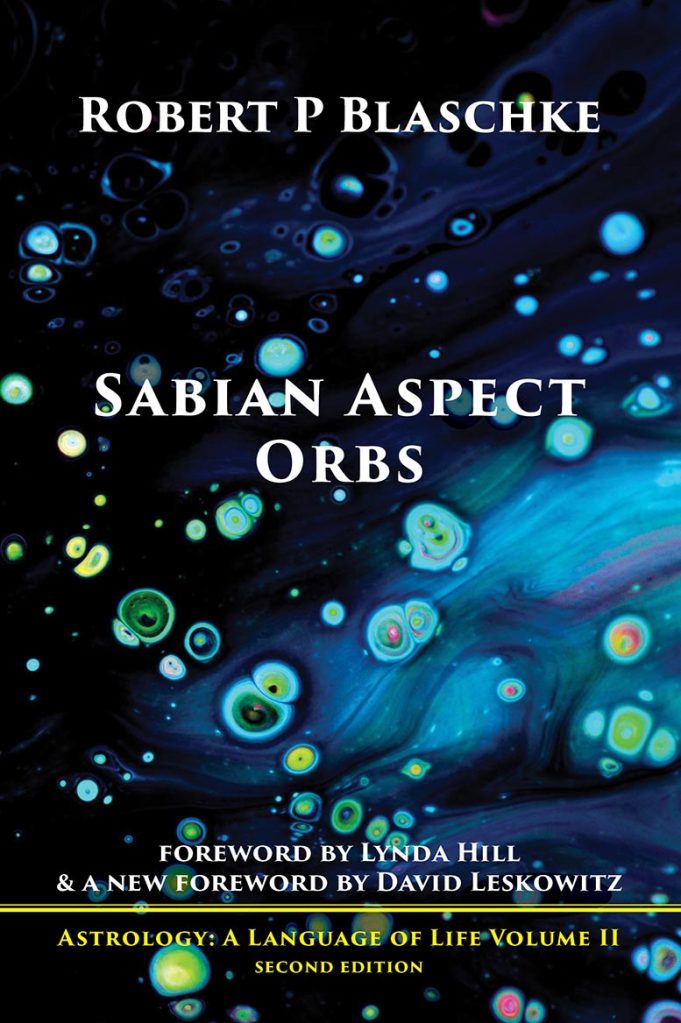
Jupiter in Gemini is many things, many-ness, manifold ideas, proliferation of ideation… and happened to be in the sky when some great astrologers were born. For example, Robert P. Blaschke, Dane Rudhyar, and Lynda Hill: all of whom were involved in the method and the madness of Sabian Aspect Orbs, Vol. 2 in RPB’s Astrology: A Language of Life series. Somehow yours truly, lacking any planets in Gemini (but rich in the Sagittarian!), found his way into the pages of the second edition of this unusual text. Gemini does host my Immum Coeli, the place where roots are formed and ancestral lineages reached: hence my joy in serving my astrological lineage.
Sabian Aspect Orbs by Robert Blaschke, second edition
Publisher and editrix Dr. Jenn Zahrt invited me to make like a Gemini and wax prolix about degree symbols in a foreword. Such a blessing for my debut into astrological print, which Jenn has supported in so many ways already: publishing an essay in The Ascendant (about TNO Borasisi), making sure I was quoted in The Mountain Astrologer (about TNO Borasisi), having me on as a guest on Within Orb (to discuss our top astro books), and now in the pages of a series whose first editions I have long treasured. In my first years as an astrology student in Berkeley CA I happened to be guided to degree symbols (through Ellias Lonsdale’s Inside Degrees), Sabian Aspect Orbs, and Jenn herself, who was teaching astrology classes downtown while finishing her doctorate. Check it out at Revelore Press (where you can also read the Foreword).
And yes, our own book nears completion too on this same mutable wave. Head over to Praesepe.Press to pre-order while you can (lock in a low price, and get the ebook for free). Now, in Spring 2025: It is Actually, Truly, Coming Soon! Thanks for your patience and support along the way.
UPDATED TABLE OF CONTENTS FOR SIDEWAYS FROM SATURN: Foreword by Louise Edington 1. Introducing the Centaurs by Melanie Reinhart 2. The Walkers by Andrew Smith 3. The Cycle of Chiron: Accepting the Wound of Incarnation by Brian Clark 4. Being Chiron by Hugh Smiley 5. Pholus: Agony and Ecstasy, Secrets and Lies by Vicky Maloney 6. Nessus Catalyzing Heroic Change by Jenny Kellogg 7. Chariklo: Wife of Chiron by Melanie Reinhart 8. Chariklo: Holding the Space For Transformation by Shellie Enteen 9. Okyrhoe: Her Call and Her Consciousness by Anandita Simon 10. Cycles of Okyrhoe in Discovery by Anandita Simon and David Leskowitz 11. Visionary Astrology of the Ecstatic Centaurs by David Leskowitz 12. Asbolus: Fire on the Mountain by Jenny Kellogg and David Leskowitz 13. The Centaurs Speak by Bobbi Rose Williams
In honor of the presently forming sextile between Queen Chariklo and King Chiron, I spent some time this winter creating my first talismanic series made out of metals. A bronze series honoring the Nymph and Centaur, when Venus conjoined Chariklo just after Chiron met the North Node; and a copper and silver series of Chiron, made prior to the Great Chiron Eclipse of April 2024.
The sextile building in the sky now between Chiron and Chariklo stems from their synodic conjunction of 1949. The present aspect is an echo of their first sextile, which formed briefly in 1994, before nearly reaching the trine in 2012. Then the pair “descended” back to their present climb, to hover in this gentle harmony for about two years, before a swift traverse toward opposition in the late 2040s. (This info gleaned from the inimitable Centaur sage Robert von Heeren’s Centaur Research site).
There is obviously much to say about the harmony between these healing guides, and their greater cycles, which I have been meaning to write about. In the constant maelstrom of unfolding trauma and tragedy, I hesitate to apply the astrological lens too quickly. But of course patterns in the sky do relate to what we experience, and the Centaurs’ rhythms may offer us a repose from the planetary energies. More on this later, especially as the aspect sharpens in the next year ahead.
As an aspiring healer and “mage”, I’ve come to find the application of their healing energies to be an even more direct route than discussion of their astrology. And while I’m happy how the clay talismans I’ve created over the past five years have brought many into connection with these Centaur friends, the use of metals to carry energy is a more well-established magical practice. These talismans of bronze, copper, and silver are made from a kind of clay that cures into a pure metal, in an alchemy that is easy to work with and very artistically satisfying. I admit that holding these new talismans in my hand brings in their now-familiar vibrations even more robustly! It appears that they “hold their charge” better than other materials, too.
As I mentioned in a recent blog, this Spring I was honored to write for the Journal of the Federation of Australian Astrologers. It features an array of astrologers born with Pluto in Libra (1970s-80s). I encourage you to read the whole publication if you can, guest-edited by Chiron’s own friend Brian Clark.
My contribution was an exploration of the mythos behind TNO Altjira’s namesake, and the mind-blowing astrology this minor planet makes, especially in relationship with Chariklo. I also try to clarify some of the confused definitions you might find if you search the “minor planet internet” for Altjira.
Without further ado: here is a PDF, with careful layout and illustrations by the kind folks at the FAA.
“Altjira and Chariklo: Weaving Gateways in Time and Space,” March 2023, TheJournal of the Federation of Australian Astrologers.
Today marks the anniversary of the Buddhist master Longchenpa, whose death – and enlightenment (in what Buddhists call a Parinirvana) – falls on the 18th day of the twelfth month of the Tibetan lunar calendar. Tibetan tradition celebrates the parinirvana dates of beloved masters, as these are considered to be ideal windows for communing with the ever-present spiritual essence of enlightened teachers. As bodhisattvas, these teachers are said to continue after death in both their “rainbow bodies” of blessings, and in physical “reincarnations” too. Every astrologer studies birth charts, but “rebirth charts” are less established! Let’s see how Centaurs can help us bridge this mystery.
Longchenpa was born in 1308 and died in 1364, and believed to be the incarnation of a Princess who lived and died in the time of the founder of Tibetan Buddhism, Guru Padmasambhava. From his predecessors, Longchenpa inherited a special lineage called the Heart Essence of the Dakinis, those mysterious feminine beings who conceal secret wisdom. In turn he granted extraordinary visions to Jigme Lingpa (b. 1729), who lived four centuries later and continued that lineage. The content of these visions formed the basis of a Buddhist path that is still influential in our time, the Longchen Nyingthig (“Heart Essence of Vast Expanse”). It is believed that Jigme Lingpa then reincarnated as Do Khyentse, the first of many lamas to bear the Khyentse title meaning (holder of) “Wisdom and Compassion”.
Throughout my study of the astrology of spiritual visions and peak experiences, while focusing on the Centaur planets Chiron, Pholus, Chariklo and Okyrhoe, one trans-Neptunian object always shows up on the distant sidelines and holding an astrological message. That is TNO Altjira, a minor planet far far away that was named in honor of an Australian Aboriginal deity, or more accurately, a spiritual concept. I’ve written about this TNO and how its namesake is more of an adverb (for “being timeless”) than “sky god”, in an upcoming article for the Federation of Australian Astrologers. (My next blog here at the Centaur Space will delve into some of the complex anthropological and philosophical issues brought up by our convention of naming TNOs after Indigenous and Aboriginal spiritual ideas.) Indeed, both astrologers (such as Sally Hildreth in her TMA piece on TNOs), and anthropologists have commented on how “the timeless” can be a fine way to avoid saying anything meaningful at all – but I will use it as a placeholder word for the idea of something that spans “all time” (even if that contradicts timeless).
Buddhists refer to past, present, and future as “the three times”. If a master, through their meditational acumen, attains sightlines across these three times, they are designated as kunkhyen or “all-knowing” – and one such master is Kunkhyen Longchenpa.
Here I will briefly trace how TNO Altjira works alongside the Centaurs and Outer Planets in the fascinating application of astrology to “reincarnational synastry,” or the astrological connections between rebirths of individuals who are considered to be beads on a chain of embodiments of the same enlightened mind.
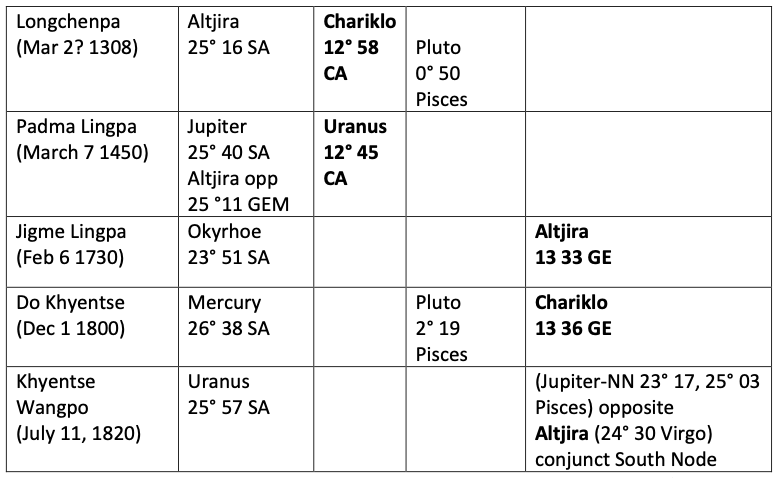
Considering the life-streams between Longchenpa, Jigme Lingpa, and the first Khyentse (from Do), all three of these figures are related through synastry with the earliest lama’s natal Altjira. At the birth of Longchenpa (March 2, 1308*) our TNO was at 25°16 Sagittarius, in future visionary synastry with Jigme Lingpa’s Okyrhoe (23°51 Sagittarius). Here Okyrhoe forms a bridge between generations just as she is an astronomical link between the inner planets and the slower Centaurs (Jupiter’s 12-year, Okyrhoe’s 24.5-year, and Chiron’s 49-year cycles in a ratio of 4:2:1). Jigme Lingpa’s own Altjira (13° 33 Gemini) is exactly conjunct the Chariklo (13° 36) of his future reincarnation, Do Khyentse. The latter’s Mercury at 26° 38 Sagittarius falls within a degree of founder Longchenpa’s Altjira, whose teachings the Khyentses uphold into the present in Bhutan and elsewhere. It seems that the dakini wisdom beings tell this astrological story through their corresponding Centaur nymph planets (Okyrhoe and Chariklo), in concert with the distant knower of vast Time, TNO Altjira.
The first Khyentse, from Do, was an outlier both within society (known as “the mad yogi from Do”) and on the rebirth tree; while Jamyang Khyentse Wangpo became the famous trunk of the mighty tree of tulku rebirths. Not only did Wangpo’s Uranus connect to the stream in Sagittarius leading all the way back to Longchenpa’s root Altjira, but his Jupiter in Pisces (conjunct Okyrhoe’s discovery degree) opposed Altjira, in alignment with the lunar Nodes.
The series of reincarnations that stem from Longchenpa through the present Khyentses include one linking lama who is held to be the direct rebirth of Longchenpa: Pema Lingpa, named for the Princess (Pema Sal) whom they each reincarnate. Jigme Lingpa, meanwhile, is known as the rebirth of the King (the Princess’ father). In a prayer he wrote about his own lives, Jigme Lingpa implies he is a reincarnation of Longchenpa (and thus the Princess), too. These stories exceed our rational mind: as religious stories meant to instill devotion don’t really have to “make sense” to us. Further proliferating into the unknowable, such rebirths from one tree are categorized into many branches: the body, speech, mind, (plus “quality” and “activity”) incarnations can all stem from the same master’s single intention to propagate a lineage through time and space.
Jigme Lingpa and reincarnations with reference to Longchenpa:
Jigme Lingpa: Okyrhoe to Longchenpa’s Altjira
Pema Lingpa: Jupiter to Longchenpa’s Altjira
Do Khyentse (body): Mercury to Longchenpa’s Altjira
Khyentse Wangpo (mind): Uranus, (‘higher octave’ of Mercury), to Longchenpa’s Altjira
(The speech incarnation known as Paltrul Rinpoche has no known birthday)
“Reincarnational synastry” is a fascinating study, one that probably won’t impress skeptics but can inspire the “believers”, of both astrology and of the saints and sages who lead various spiritual traditions. Astrology provides the symbolic apparatus upon which we may place such unknowables as the existence of lives beyond death, and the newer planets in our Solar system may hold some crucial new keys to this mystery.
Birth info:
*For Longchenpa, there is discrepancy among traditional sources over day of week so here it is enough to say “early March 1308.”
Jigme Lingpa: 6 February 1730, Tibet Source Biography, “born in early morning of 18th day of the 12th month of the Earth Bird year 1730, Thondup p. 118
Do Khyentse 1 December 1800, Tibet (on Full Moon, Moon applied to Chariklo) Thondup p. 180 “born on the fifteenth day of the tenth month of the Iron Monkey year of the thirteenth rabjung cycle.”
Pema (Padma) Lingpa: His birth was on the fifteenth day of the second month of the male iron-horse year of the eighth cycle, corresponding to March 7 1450.
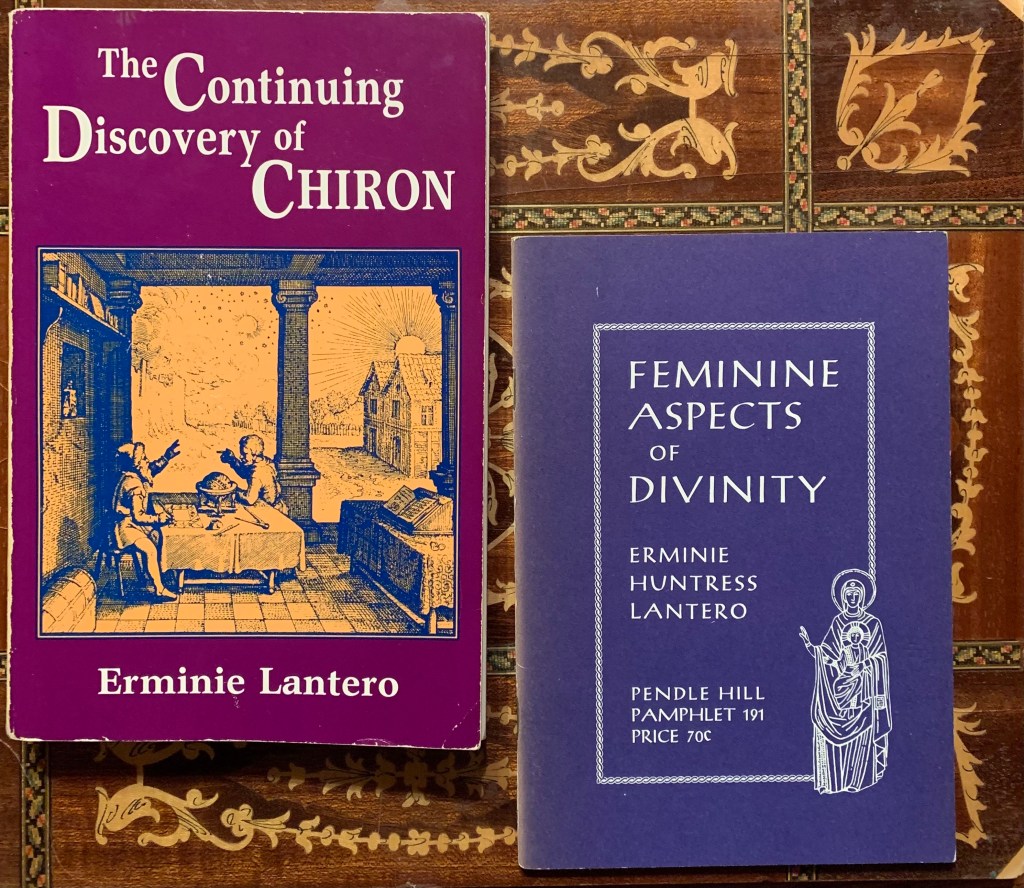
In honor of “Chiron’s Birthday”, November 1, the anniversary of the discovery of minor planet 2060, AKA Chiron, in 1977, it is fitting to take a look at the life of one of astrological Chiron’s earliest adopters. I was introduced to Ermine Lantero’s Continuing Discovery of Chiron by Melanie Reinhart, who spoke glowingly of this book, written about the harbinger of a class of new planets so soon after its discovery, by a woman who was enjoying the final decade of her life.
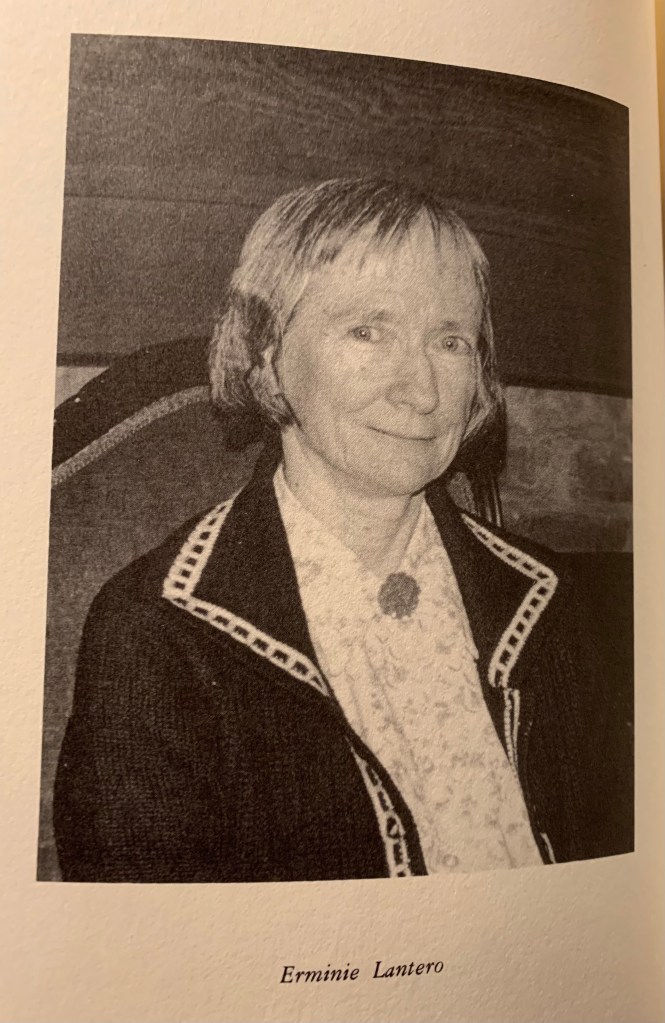
Erminie Lantero’s place in the lineage of Centaur astrology is a keystone, one nearly forgotten, or at least under-reported. A student of theology, then college teacher and editor of spiritual literature, later a science fiction enthusiast, before finding and making space for astrology, it seems that her long and winding road prepared her, at the age of 74, to become one of the first authors on minor planet Chiron. New research shows just how fated was this starry role – and how her life aligned with the Chiron archetype. This year Chiron transits around her natal Sun in mid-Aries, too.
What planetary propensities might an astrologer read into the little bio she wrote in Lamarada, her yearbook at Mount Holyoke College: “Erminie is interested in all kinds of initiations; that is the only thing about her which has not changed since Freshman year. She changed her major twice a year, and her philosophy of life once a week. She wanted to be an ascetic, but liked to eat too well.” Not quite Saturn, not quite Jupiter, but… someone who was a relation of each? Initiation is a resounding keyword of the master healer and teacher Chiron.
I began to write this with the thought that Erminie’s was the first book written on the subject;it turns out that while she had completed her writing before any other book was published, Richard Nolle’s Chiron: The Key to Your Quest was published a bit before hers. She notes her own anticipation of Nolle’s book in an appendix, where she cites one source already dated Feburary 1983, while Nolle’s was published in the summer of that year. Thus, these foundational texts of Chiron were written simultaneously, by two very different astrologers.
As a pioneering book on the subject, Lantero’s thrill of discovery carries us through the initial days and months after Charles Kowal realized that a photographic plate he took two weeks earlier depicted a tiny but new body in space. From November 1, 1977, it took astrologers only eight months to hold an ephemeris in their hands, thanks to cooperation with astronomers like Brian Marsden, and the persistence of Zane Stein and his Committee. Continuing Discovery reminds us of others whose names I’d not yet learned, such as Joelle Mahoney, a VP of the Congress of Astrological Organizations, who was the person on the phone with Kowal for the discovery details (and his birth date, naturally) and who organized the first ephemeris software to be written. And Lantero reminds us that it was James Neely, an astronomer, who programmed one of the first astrologer-friendly Chiron ephemerides, equipped with declination and retrograde stations.
These minutiae are worth mentioning here as such details can fall by the wayside as our astrological science evolves so rapidly, as the Solar system expands with the continuing discovery of the Kuiper Belt and the vast trans-Neptunian realms. Lantero’s early compendium of Chiron lore – both of its mythos and its more recent history, remains vital for drawing together so many sources from now faded analog forms of centaur-ephemera. While students of the minor planets now have access to online repositories of astro-banter dating “all the way back” to the internet’s early days of the 1990s, Chiron’s discovery fell in that liminal world of photocopied bulletins and long-distance telephone calls of the late ‘70s and early ‘80s: you can’t find this info anywhere else – at least I hadn’t. The elder writer’s excitement for the novelty of it all (the first time a planet was discovered in the age of technology) illuminates a work that feels both cozy and technical, replete with all the bibliographic references we expect from a writer who spent her career as a biblical scholar and editor.
But as she admits, “editors are frustrated writers,” and that frustration fueled a crisis that coincided with a later in life Chiron square. She found her way as an astrologer when, after “Progressed Sun reached her Pluto, she inadvertently stumbled into astrology,” aged approximately sixty-six. Thus she found astrology in 1973, four years prior to Chiron; and ten years prior to her book. The autobiographic morsels (delivered here in the style of an omniscient narrator, without revealing it is her own story she is writing) which she does share with us (in her chapter on “The Chiron Cycle”) are the most revelatory fragments about her life we have in her own words. She briefly mentions “childhood traumas and unusual family conditions.” While the following biographic information was not disclosed in the book by the admittedly “shy” Erminie Huntress Lantero, I consider that reaching a more fully sketched life story of one of our elders to be a gesture of respect.
When I received her Pendle Hill Pamphlet entitled Feminine Aspects of Divinity, I was surprised to see “Huntress” included in her name. Since she is styled simply “Erminie Lantero” in more recent book, I wondered if this was a spiritual epithet or nickname? Thanks to genealogical information now shared by her relatives on a public database[1], we see that Huntress is actually her maiden name; both that of her biological mother – and also of her adoptive parents. Her maternal uncle adopted after her mother died when she was four.
How Chironic than she was an adoptee! Raised by her mother’s brother and his wife, named Grace. As if she herself was one of the centaur’s brood of foster children to be nurtured by that spinner of grace, Chariklo, wife of Chiron. (This hits close to home for me, as Grace was raised in the small village in Massachusetts where my family presently resides.)
Chiron was himself adopted by Apollo after Philyra rejected her halfling son. Likewise he raised the son of Apollo, Asclepius, who became a god of healing under his tutelage. Chiron and Chariklo fostered many heroes and healers including Achilles, who in the Iliad is praised for his healing abilities.
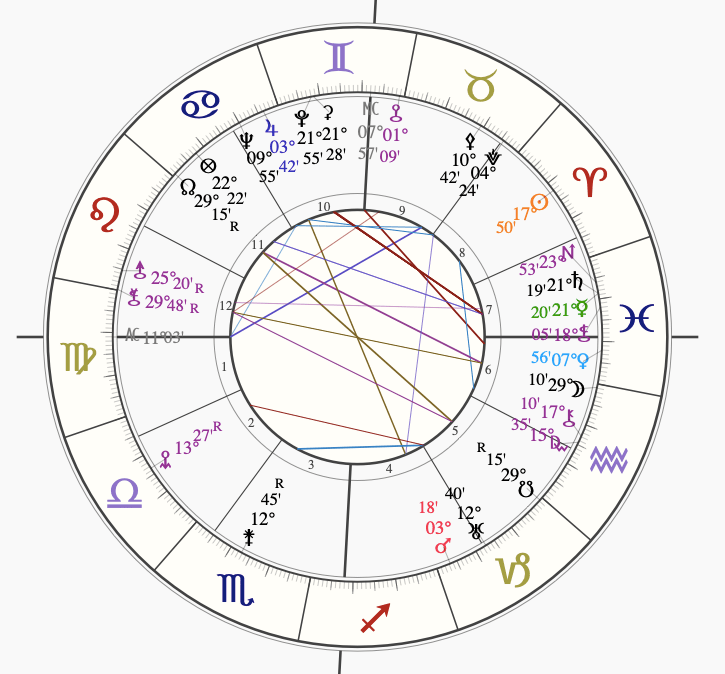
According to her own rectified birthchart, her Ascendant in mid-Virgo is very close to the degree which, as Robert Blaschke[2] observed, is a potent point in Chiron’s discovery chart: both the Sun-Moon and Venus-Mars midpoint, which bears degree symbols tying it further to the Chiron myth, in ways that Erminie herself lived out. 11° Virgo: “As a boy ages he looks less and less like his mother” (Pleiadian), from the Sabian version “A boy molded in his mother’s aspirations for him” (Marc Edmund Jones’ Sabian Symbols, 1953).
While this is not the degree symbol for the Ascendant as per Erminie’s own rectification, the data as given does actually place her Ascendant at 11° 14 Virgo! Thus, close to Chiron’s double midpoint and that evocative symbol. (The conjectural Ascendant of 13° Virgo 14 as shared on page 108 of Chiron is listed as “Chart 13, Astrologer”, with “Time speculative, partly rectified”). Thanks to astrologer Tieshka Smith[3] for casting the correct chart with modern software. Although Virgo 14’s Sabian: “A family tree” (Jones 1953) is relevant in the present context as well!
Following the death of her husband, Erminie found time “to catch up with all that had happened in astronomy since one of her most thrilling childhood memories: the day her father first explained to her in detail that the Earth was a planet, and there were also other planets circling around the sun.” After a series of eclipses to her outer planets, “she suspected she had been an astrologer once before, in the Middle Ages, and resolved to devote her next lifetime entirely to astrology.” (p.108). (The Jan. 1973 Capricorn Solar eclipse fell near her Uranus, and June 1973 Cancer Solar eclipse fell close to her Neptune)[4]
Her own second waxing Chiron square found her in an existential and health crisis, after a period when she struggled to balance her editorial work with her new-found love of astrology.
“She suspected the decisive factor behind it all was Chiron in 9th house squaring Chiron in 6th” (p.110), in addition to “unwelcome attention from all the slow movers” including Neptune opposite Pluto-Ceres and Uranus square Moon. With Chiron breathing down her back, Erminie had to fight her own death-wish, realizing that “she must not die because she had not yet done her bit to release Prometheus…,” her astrological wisdom for humanity.
Thanks also to Smith for parsing out from the brief sketch just which eclipses the author mentions as catalyzing her path back toward astrology and on to Chiron: August 10, 1980, marking her spiritual and health crisis. Then “on a February eclipse exact on her Chiron” she began to write this book. (Feb 4 1981 eclipse, 1 degree from her Chiron).
The second chapter of Continuing Discovery, “The Second Discovery: a Myth Almost Forgotten,” bridges that now-familiar mystery of how a planet’s name can express its namesake, a question which she explores methodologically in the next chapter, “Exploring the Present Meanings of the Planet Chiron.” From our present time, the willingness to explore how astrologers attempt to make meaning of the new planets remains one of the book’s strengths. She writes with the precision of a historian and provides all the bibliographic information one could hope for on both the mythology and the chaotic cross-firing of modern astrologers in the early days of the Centaur era. The ‘archival details’ come back in full force with the appendix of “Late News Breaks: Summer-Fall 1982” (when I happened to be in gestation myself).
When I found John Updike’s novel The Centaur a year ago, I was amazed that it had utterly escaped my awareness till then. So I was pleased to find that in the final pages of Continuing Discovery (pp. 154-159), Erminie gives her own book report on George Caldwell, the titular Centaur whose family includes a Promethean son and a Chariclo-analogous wife. Lantero notes how “there is something very strange in the timing of the story. Both Caldwell’s father and he himself die on their Chiron return, and Caldwell’s birth and death occur within a year or so of successive perihelions of the planet – although the novel was written … before anyone knew the planet existed.” Furthermore, Updike’s book was published on the Aquarian eclipse of February 4, 1962, one that was also conjunct both Chariklo and Pholus, two other Centaur planets, before anyone knew of their existence. (See my article on the astrology of its release here[5]).
Lantero wove together strands of a Centaur still in its infancy, and with her death in late 1992, left our world on the cusp of the Centaur Age when we discovered that the maverick was not a loner but a king of a wild domain of eccentrics. I wonder if in her final year, living at a senior home in the lineage of Rudolf Steiner, she learned about the discovery of Chiron’s first companion in the sky, Pholus (January 1992).
She observed how the new planet emerged in a zodiacal degree shared by her natal Vesta: a Priestess of this new-found flame. Where would the others be? Chiron’s kin, once found and named, how were they constellated in our protagonist’s natal chart? Moreover, what do they reveal about her synastry with the hoofed healer? Much as Updike wrote his George Caldwell as an uncanny Chiron character before the planet itself was known, Erminie followed the Promethean call to the Centaurs before she would be able to cast a chart full of them.
In this spirit we may examine some of the connections between Erminie and the discovery of those planets that arrived into our view mostly after she departed this plane. It appears they are rather intertwined!
Erminie Greene Huntress Lantero: born April 8, 1907, Hightstown NJ, 3:20 PM – speculative time (her own rectification).
Chiron is conjunct asteroid Asclepius (#4581, discovered in 1989) within 10 arc minutes (not shown, at 17° 20 Aquarius). A double signature of the healer, and also of the adoptee.
Factoring in Chariklo to her nativity, we find the Centaur Queen near the author’s Mercury-Saturn conjunction in Pisces. How fitting that she found astrology after her Chariklo return, and eased into the healing work beyond the merely academic route that her theological career veered toward (as signified by Mercury-Saturn in Pisces!). Nearby, Nessus approaches the eventual discovery degree of Okyrhoe, which implies a thirst for truth. Spiritual Jupiter-Neptune conjunct in a water sign, close to a Neptune-Uranus opposition which defined that era of revolutionary movement, (and which marks the epiphany of Rudolf Steiner, founder of what would be her chosen spiritual path at the end of her life).
Sun opposite Pholus, which is at the future discovery degree of Asbolus, in Libra, speaks to the need for ritual balance in life.
Her own lunar Nodes, at the end of Cancer/Capricorn, align exactly with the heliocentric planetary nodes of Pholus and Chariklo, bringing her life-path into the cosmic Centaur design.
Moon opposes Cyllarus…which we will return to.
Synastry with Centaur Chiron’s discovery (November 1, 1977): Of course this event is a transit in her life, but we can read it as the chart of a friend, too. “His” stellium at the Midheaven of Vesta with North Node and Pluto (which depicts the “mission” of transformation this planet brought) is conjunct her Pholus. A sudden reverie gives one their calling! And, as she noted, Chiron’s discovery placement conjoins her Vesta. She found her spark and the lamp that lit her path. She and Chiron share a Jupiter in Cancer within a degree: they are on the same spiritual wavelength (and as one of her four exalted planets, a strong basis for friendship).
Centauress painting by John LaFarge; maybe Hylonome!
Chiron’s Moon conjoin her Neptune, a sure sign of inspiration. His Pholus is near her Chariklo. The Centaur’s Saturn opposes her Moon, and her own Cyllarus meets Chiron’s Saturn and Part of Fortune. This connection opens an important thread of synastry between the Centaur and astrologer. Her husband, Peter Lantero, died in October 1963, with Saturn transiting her Chiron and approaching her Moon. Then her “cosmic teacher” emerged from the heavens when Saturn reached its opposition to her Moon.
It is startling that both Chiron and Erminie both have an exact opposition between centaur Cyllarus and the Moon. Further, both nativities share the trait of Cyllarus-Hylonome oppositions by sign. (This aspect is persistent throughout the 20th century, however!) These two centaurs are the “Romeo and Juliet” of the Kuiper Belt. Furthermore, Chiron’s discovery Cyllarus is conjunct her Uranus in Taurus, with discovery Saturn conjunct her Cyllarus. Once her partner passed away, she found a new identity as an astrologer with her own authority forming in an unexpected realm. At her birth, Cyllarus in Leo is on kingly Regulus, exactly opposite the Moon, which is with Hylonome, the loveliest lady Centaur.
Learning that she had Chiron in Aquarius mean that her “dream of nourishing the minds and souls of others through some kind of analytical activity was a dream she was entitled to follow” (p. 109). Leafing through its pages and continuing to discover the abundant nourishment within her seminal text, I appreciate that she was able to fulfill her stellium in Aquarius, flanking natal Chiron: Hylonome the Centauress, and Asclepius, the student of the master healer.
Quotes from: Lantero, Erminie. The Continuing Discovery of Chiron. Maine: Weiser, 1983.





 The Centaur Space